A look at 3 designs that amplify their brand’s message
New global brand narratives
As designers, we more than ever need to look at language as a tool to implement excellent design. In today’s fast-moving brand environment, telling the brand’s story through visual wording is a crucial design strategy.
We have a one-go shot to tell the audience our brand story with one or a few words. If we have a mature brand, then a word like Apple is enough to grab everyone’s attention. The same goes for this brand’s iconic symbol.
But how do newer brands tackle one of the most difficult brand challenges, that of writing their own story?
A look at three examples.
1. The story of On

On is a sportswear and running shoes company. It was founded in 2010 in Switzerland. Back then, Olivier Bernhard, retired from professional sports with plenty of free time, wanted to create a running shoe with a totally new feel. He started to experiment, building his own shoes by gluing pieces of his garden hose to the soles of his new prototype shoe. The results were stunning. Smoother and more efficient on his feet, Bernhard knew he was onto something.
Soon after, two of his friends, Casper Coppetti and David Allemann joined his efforts, and the rest is On innovation history.
On’s market share has been increasing steadily and mightily over the last 15 years, giving major sportswear companies a run for their money.
On’s design story
The On logo consists of 2 letters, the ‘o’ and the ’n’. In combination, the letters look like an iconic person ready to go places. The lines are bold. The accent on the ‘o’ suggests the person’s nose taking in fresh alpine air.
Or, the ‘o’ accent could reflect one of On’s trademark design, the CloudTec® technology, built-in air spaces in the soles of the shoes that soften landings and enhance take-offs. This CloudTec® technology launched the brand back in 2010.
The design play on the word On is brilliant. It swiftly tells the story of being switched on, of being ignited, motivated, and equipped to take on the world.
Their Oniverse is a grassroots community action and next-gen tech experimentation that embraces sustainability by using fossil-free materials.
The On mission: To ignite the human spirit through movement.
On has launched stores in places such as Hong Kong, Tokyo, Paris, Zürich, London, Berlin, Milan, New York City, Miami, Newport, Los Angeles, Melbourne, Santiago, and other cities.
2. Ralph’s love of the ever-enduring coffee society
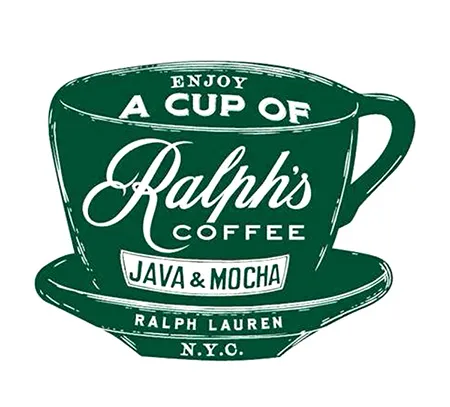
The iconic design for Ralph’s Coffee, a co-brand of Ralph Lauren clothing. The design tells the story of enjoying a cup of Java & Mocha at one of Ralph’s coffee shops, and if not at at the coffee shop, then certainly at one’s home with one of their specialty coffee blends.
Ralph Lauren’s first-ever coffee shop, Ralph’s Coffee, opened in 2014 in New York City, evoking a sense of the timeless American spirit of the namesake super-brand. It has since overtaken the NYC coffee society by storm.
Ralph’s Coffee icon design symbolizes the timeless social activity of enjoying a cup of coffee together in a bright and authentic atmosphere.
A smorgasbord of fonts adorning the flat green graphic of the coffee cup reminds one of an era of fancy diners and eclectic coffee shops. Equally, the saturated porcelain green of the cup and saucer suggest a privileged and priceless experience, much in contrast to today’s culture of the throw-away paper cup.
At Ralph’s coffee shop, time is the ultimate luxury, meant to be spent lavishly and generously. Coffee (along with tea and chocolate) revelers are invited to enjoy a generous dose of coffee society hospitality.
Ralph Lauren’s coffee shop mission: To bring people together and evoke the true meaning of hospitality.
Ralph’s Coffee has branches in places such as Hong Kong, Beijing, Tokyo, Doha, Munich, London, New York City, Miami, Washington D.C., Chicago, and many other cities.
3: Uniqlo’s message of global wearables
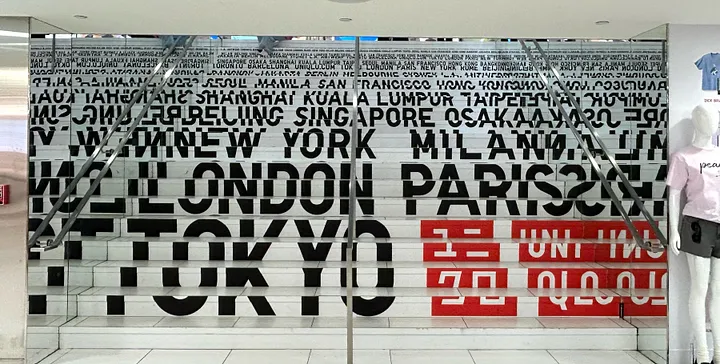
Uniqlo’s stairs at their New York 5th Avenue flagship store, combining typography of their locations with the three-dimensionality of the stairs. The steps lead to a café and more open retail space.
Uniqlo is a Japaneses clothing brand headquartered in Tokyo founded in 1949 as a textile manufacturer. It since has grown into a global brand selling innovative and comfortable clothing.
Rather than chasing trends, Uniqlo focuses on functional basics and simple, high-quality clothing embracing quality cotton and linen fabrics.
In Uniqlo’s flagship New York Store on Fifth Avenue, typography, architectural design, and visual identity unite to form an interdisciplinary space.
Walking up and down these steps feels like a catwalk in a global sense. One could be in London, Tokyo, New York City, or Paris, wearing an identical printed t-shirt design with art by Matisse or Picasso and feel the same exhilarating rush of possibly being part of an ultimate global fashion statement.
Uniqlo’s philosophy: ‘LifeWear’, creative clothing that is innovative, comfortable, and adaptable to everyday life.
Uniqlo has branches in countries such as Japan, Mainland China, Hong Kong, Taiwan, Korea, Singapore, Malaysia, Thailand, Philippines, Indonesia, Australia, Vietnam, India, USA, Canada, UK, France, Germany, Belgium, Spain, Sweden, The Netherlands, Denmark, and Italy.
Closing thoughts
While these past decades have been emphasizing global manufacturing and trade, a different type of local manufacturing might be the rule of the future.
Brand design will need to adapt to these new structures. Brand’s that have been pushing a global story of society, such as Ralph’s Coffee, or global community, such as On, will need to realign to new values such as local manufacturing and sourcing, and local traditions at large.
Based on the intriguing narratives these brands have already built, a future edition of their design and story telling will be eagerly anticipated, at least by me.