
In hopes of seeing more of it
It’s thanksgiving season, and one of the things I’m grateful for are some recent words from architect and management consultant Gareth Stapleton, which helped me finally put together the thoughts I’d been sitting on. “Too many architects wear their ignorance of finance as if it were a mark of purity” (2025) hits hard, and perfectly condenses some of the tension I’ve felt from time to time between the “design” and “business functions” in the companies I’ve worked with. There is a very palpable aversion some designers express towards “other aspects of the business”, preferring to “focus on doing their own work well” than get involved in larger conversations on sales and strategy. You might hear stiff verbal expressions like “I’m not really interested in [that stuff]” or comments that subtly undermine “I’d rather do more to solve the problems that actually improve people’s lives…”, delivered with just the slightest upturn of the nose.
The problem with this, at least to me, is that sentiment is inherently counter-productive to the way designers should be thinking. I’ve touched on the value of design to organizations in previous articles: designing for the New Space Age and how design-driven organizations are crucial to progress, so when Gareth says “The future belongs to firms that treat themselves as design problems”, I’m inclined to agree — as designers, we’re taught to consider the context of each problem we’re solving, and so if the problem is the organization’s existence, what it stands for and how it exists, wouldn’t the context naturally include those “other aspects” of the business?
I mean, if people never get to know about the product (brand awareness from marketing efforts) or what it does (communications) and how to purchase it (sales and distribution) or if the service is discontinued due to unprofitability (finance, accounting ) etc., how is it going to help them?
The importance of Systems thinking
So what is systems thinking and how does it help anyone? Is it for everyone?
The Oxford English Dictionary defines a system as “a group or set of related or associated things perceived or thought of as a unity or complex whole”. Talking about systems generically may seem foreign until you consider some common uses of the word: our digestive system, the metric system, sewage systems, security systems, education systems, value systems, ecosystems, the solar system. For designers: Design Language Systems. We often say things are “systemic” particularly when talking about sociopolitical and economical issues, and we use the word “systematic” to acknowledge structure and organization in things.

It’s also the title of The Bear’s debut episode featuring accoladed chef Carmy struggling to implement a new set of rules in the crowded kitchen of a small beef sandwich shop in Chicago. The first few episodes do a great job of showing us that working with a system can be difficult, chaotic, and downright frustrating at times — and that it would easily be ten times worse without one. Plus, it delivers customers a consistently delicious beef sandwich.
If you really think about it, there are a lot of things around us that could qualify as systems, if we choose to think of them as such. For situations with many moving parts (i.e. variables) where you want to achieve an optimized outcome consistently, it’s natural to put more effort into arranging every single detail to give you the best chance at success, whether that’s ensuring a loaf of bread is baked perfectly, the fridge always has enough ingredients to whip up a meal, that not every single one of your friends shows up to thanksgiving with mashed potatoes, or something else entirely.
The real fun begins when you get into the habit of deconstructing and reconstructing things because you’ll start noticing all of the little details and parts that make a whole. Here’s a couple more examples where systems thinking makes a difference:
A Product

In a 2024 WSJ video documenting how artist Stuart Semple and his team attempt to replicate the coveted International Klein Blue paint, Ellen Davis, Associate Paintings Conservator at Harvard Art Museums says “I think a lot of people think of it as being a pigment, but IKB is actually a paint system, a mixture of synthetic ultramarine and polyvinyl acetate resin diluted with solvent. The effect is very matte and that gives it that kind of chalky velvety quality.”
If you watched the video, you’ll see that trying to recreate that specific shade of blue is a very systematic process. If the team didn’t adopt a systems perspective on the paint, it would be difficult to figure out what exact combination and ratios of components would give them the outcome they were hoping for.
A Set of Products
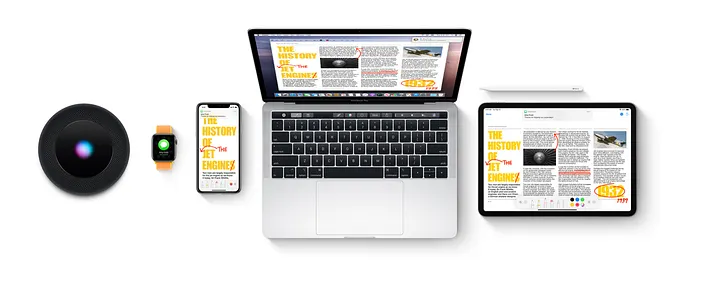
The same sort of ideal outcome can be achieved across multiple products. You can’t really talk systems without mentioning Apple, so to be brief, I’m borrowing these words from Erwin Karim (2023): “Apple Ecosystem is arguably Apple’s best product, although it is invisible and always lurking in the background. Apple Ecosystem is an experience, an environment that only works with Apple products. Works great on its own, but better with each other.”
A Product that helps you make Products
I wanted to give a shoutout to a third category of products that is becoming more commonplace: Rive is a browser-based tool for building production-ready UI and graphics that boasts rich interactivity and state-driven animation.
One of the key features that enables building the smooth interactions is its State Machine. Rive describes this as “a visual way to connect animations together and define the logic that drives the transitions”.
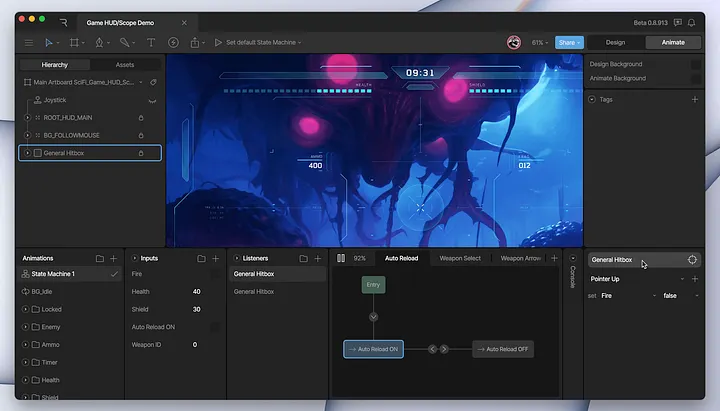
Basically, the user is designing a system that determines which state an illustration (say an emoji) should be in (is it happy, angry, or sad?) and what triggers a transition from one to another (maybe it gets angry when on mouseover or click).
Since one of the users’ main objectives is making their own sets of rules for the UI components, websites, videos, games, and worlds that they create, a systems thinking approach is more overtly required to set up the logic in a congruent and harmonious way across all the elements involved. And what more if you’re on the team building these products!
When I heard they were hiring about 2 weeks back, I had to have a look at their job description for a “Design Engineer”. There was a section that said “Given that Rive is a new type of design tool, there’s a lot of opportunity to define and shape entirely new tools and ways of working. We have some unique and complex problems to solve.” My first thought was that the team building these products at Rive must have lots of fun, meta type discussions just like we do — our team at Charter Space builds Systems Engineering tools for teams building satellites and other complex systems. “Designing Systems for Systems Design” is how I like to talk about my work nowadays, but it’s not always for everyone…
Is there such thing as “Too much of a good thing”?
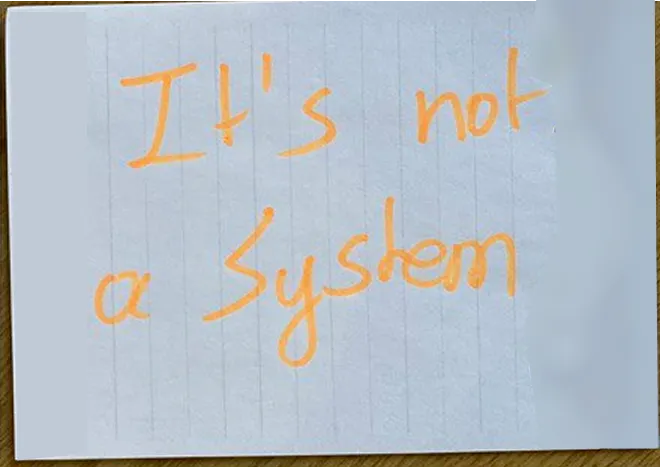
Many things can be systems; not everything should always be treated as one.
For a given problem, we can define an objective function, note down assumptions and constraints, then devise a solution that satisfies all criteria and maximises/minimises the objective function — i.e. the optimal solution.
This is easier said than done, especially since systems thinking involves problems with more complexity, require greater collaboration across disciplines, and have a longer time horizon (IDEO, 2025). Because of the sheer number of things to be considered, several assumptions or variables will probably have changed in the time taken to just do a first pass. You usually end up having more assumptions (= more uncertainty and vagueness of problem space) than most people are used to working with.
As designers who have more experience in working through the uncertainty, it is also our responsibility to help coworkers through it, and to impart these skills to them over time. Trying to introduce too much variability suddenly can result in a lot of stress, and it’s important to take time to find the right balance for your team in terms of frequency and process for tackling systems design problems.
If you’re growing your team, you might want to consider whether you should be looking for someone with a systems thinking mindset. They may not have the word “systems” in their previous job title, and you may not even be hiring for design roles, but there are things you can look out for all the same.
What a Systems thinking mindset sounds like
“So, why did you apply for this role?”
I was once asked by a team hiring for both UI and UX roles why I applied for the former (over the latter). This was after they’d seen some of my graphic design work, so they were curious about my motivations in potentially doing less graphics and more process-heavy / rough sketch work as described in their job description.

Having thought about this before applying, I was able to answer fairly quickly, saying that I didn’t want to just design products, I wanted to design for the ecosystem they belonged/existed in, since after all nothing really exists in isolation and the UX role just seemed like it would offer opportunities closer to that (they nodded, and I did land the role 🎉, so I think this response made sense to them).
But to clarify, my view is that a designer is a designer is a designer. One may be more adept at one aspect of design than another, but the core character of designers as curious, resourceful problem solvers stays the same. Figma Designer Advocate Hugo Raymond remarks on the comparison of UI and UX design, “Many people confuse UI and UX….these roles should be based around the individual designer’s competencies, rather than a prescribed title”. So for companies that take design seriously, the job title or description are probably more of a reflection of the kind of design problems you might be able to work on, rather than the boundaries they are trying to set for you within them.
Honestly, if that company had listed a Systems Designer role along with the other two, I would probably have applied for that instead.
All this to say, the word “systems” doesn’t have to come up for someone to be demonstrating systems thinking. There are many more ways a person can express their proclivity to making sense of complex contexts.
“And do you have any questions for me?”
As I began conducting interviews myself, this quickly became one of my favourite questions to ask. Not only because it seems the fair, reciprocal thing to do (having asked them a bunch of questions before that), but also because the questions someone asks often tells you more about them than any answers they give.

If speaking purely about systems thinking, the best candidates I’ve spoken to are those who ask questions that:
- Demonstrate deep contextual understanding of their prior work; it’s not enough for them to simply solve the problem, they have truly digested the environment in which the solution exists to ascertain whether it truly solves the problem or not.
- Demonstrate some contextual understanding of “other” work: they’ve been genuinely interested in the lives and workings of people they’ve collaborated with, and they’ve gained some of this adjacent knowledge as a result.
- Show comparable enthusiasm in what the company does: this sounds a bit like common sense, but I have met many individuals who showed a very different degree of interest in the “design” aspects of the team versus the company itself, its offerings, and its business model — even though that has an obvious connection to how it will make money to sustain their job security, especially if we’re talking about startups.
- Reflect a clear mental model of how the world works
*By the way, none of these contain any mention of accuracy or correctness because we’re just talking about the ability and tendency to think through things to a high degree of “completion” or thoroughness.
A Rebellion of Sorts
Amidst the commodification of design, let’s not forget the core of our work as designers. Let’s be bolder and more intentional in our thoughtfulness, and let us not be afraid of the unknown.
The future belongs to firms that treat themselves as design problems, and those firms will be driven by teams who are able to think in terms of systems.