
Combine your ‘Customer Journey’ with the ‘Journey of the Hero’ to make your marketing an adventure
Your customer goes on a journey, like every hero in every story ever told.
By using mythic storytelling, you can create a map for your Customer’s Journey — from the problem they face to the solution you provide.
In his classic book The Hero With 1000 Faces, Joseph Campbell wrote about the monomyth. From Beowulf to Star Wars, he says, every great adventure follows the same Hero’s Journey. Every hero goes through a specific series of stages and challenges. This mythic structure has been used by countless authors, and it is the framework for many of your own favourite stories.
If your business applies the Hero’s Journey to your Customer Journey, you can craft a compelling, mythical experience every step of the way.
The secret is: Make your customer the hero.
What Most Marketing Gets Wrong
You are not Luke Skywalker. As much as you like to talk about yourself, the customer journey is not your story. You are not the hero of this adventure. The hero is your customer.
Your role is Yoda. You are the wise mentor. As the sage who equips the hero with the tools, the map, the mission, and the means to get to their goal, your role is as a supporting side character in their story.
“You are not the hero of your customer’s journey. Your customer is Luke Skywalker, and you are their Yoda.” (clicktotweet)
If you can take on a supporting role and stay out of the spotlight, your customer will come to you when they need your help.
The Stages of the Hero’s Journey
There are 12 stages of The Hero’s Journey, as defined by Joseph Campbell, and refined by Christopher Vogler.
Vogler was a screenwriter who took Campbell’s work and adapted it to screenwriting. The Writer’s Journey: Mythic Structure for Writers has become a classic manual used by screenwriters to create a full adventure arc within a two hour film.
We can look at this combined story arc as a three act sequence, with each act containing four story beats.
Act 1: Marketing
The first four stages in the Hero’s Journey take place in the world of the common day. Before the hero embarks on her adventure, your customer goes through a predictable series of events that culminate with meeting you.
- Pain Points
- Qualified Lead
- Objections
- Introduction to You
It’s estimated by Hubspot that consumers go through 70–90% of the buyer’s journey before contacting a vendor. If you can provide them a map through this first stage, they will contact you when they are ready to go deeper.
Act 2: Sales
The second act begins with crossing the threshold. When the hero exits the world of the common day and enters the New World, he encounters tests, enemies, and allies. Upon entering the inmost cave, the hero faces a supreme ordeal.
5. Discovery Conversation / Whitepaper
6. Compare Options
7. Buying Decision
8. Payment and Checkout
According to a study by Walker, 86% of buyers are willing to pay more for great customer experience. This means you can charge a premium price if you curate a good Customer Journey.
Act 3: Service
The final third of this adventure begins with the reward. This is when the customer gains access to their purchase, you email them your content, or you ship it to their door.
9. Access Purchase
10. Solve the Problem
11. Positive Outcomes
12. Tell Others
Aberdeen wrote a brief calculating that 54% of the ROI for marketing was with the Customer Journey. If you are not making a clear map of the journey from stranger to customer, you are leaving money on the table.
Maps are meaningless unless you can orient yourself to your current location.
1. The Ordinary World / Pain Points
Every hero starts in the world of the common day. Without an Ordinary World to serve as the foil to the adventure, we don’t know why the adventure is anything special.
When Frodo wanders around The Shire, enjoying its simple pleasures, this plants the seeds for context and depth for his character arc in Lord of the Rings. The personal changes that happen later in his adventure will matter more because we see his ordinary world.
Your customer has a series of problems they are accustomed to facing. These problems cause them difficulty. Many other people in the Ordinary World just shrug and accept these problems and pains — but not your hero.
2. The Call to Adventure / Qualified Lead
When the hero decides they have had enough, and is committed to making a change, that is when they accept the Call to Adventure.
When Neo sees the white rabbit in The Matrix, he acknowledges there is an adventure out there in the world and chooses to leave his apartment. He shows himself willing to leave his normal problems, and take the chance that this unknown adventure will improve his life.
While you could help just about anyone in the Ordinary World, there is a prerequisite action they need to take before they become a Qualified Lead. This action might be requesting a quote, or subscribing to your newsletter, or experiencing a specific life event. If you can identify this critical step, you can encourage (or watch for) people in the Ordinary World who are ready to answer the Call to Adventure.
3. Refusal of the Call / Objections
Luke Skywalker wanted to leave home in Star Wars: A New Hope, and his uncle gave him a list of reasons why he had to wait. The harvest season was coming up, the academy would be there next year, and the unspoken objection — he had too much of his father in him. Later, when Obi-Wan said to Luke, “You must come with me to Alderaan,” Luke refused the call, burdened by his ordinary obligations.
When your customer says, “I don’t think this is really worth it,” they are articulating the reasons why they shouldn’t do business with you. These objections are a natural part of the Customer Journey, and they don’t mean the story is over. This friction is required to ensure that the hero really wants to go on this adventure. They have to be willing to endure the risks if they want a chance of success.
4. Meeting the Mentor / Introduction to You
Arthur was an ordinary boy, living an ordinary childhood until he met Merlin. The wise old mentor taught him the powers of Excalibur and revealed to him his true nature.
Your customer does not know how much better life could be until they meet you. As the wise mentor, you can guide the hero through transformations that will improve their life for the better. Describing these benefits, and challenging your customer to accept these changes, brings the customer out of Act 1: Marketing, and into Act 2: Sales.
5. Crossing the Threshold / Discovery Conversation
Dorothy looked around the new world of Oz, where everything was unfamiliar. The tornado had taken her from the bland Ordinary World, and into an Oz filled with bright colours and singing munchkins. Her adventure began in confusion.
The Discovery Conversation, or whitepaper if it’s not a live one on one conversation, is your opportunity to educate your customer about all the new options available. This orientation helps them make decisions about how they can do business with you.
6. Tests, Allies, & Enemies / Compare Options
Mounting his broom, Harry Potter goes onto the Quidditch pitch to earn points for Gryffindor House. His enemies on the other team are supported by his enemies in the stands. Throughout the game, he is tested by their schemes, and saved by his allies.
Your customer puts your offers through tests, comparing it to other options, and researching your competitors. Your offer is like the Golden Snitch, and it’s hard for them to catch it if they are distracted by all the competing options.
The greatest enemy always looms: doing nothing. Many customers leave their journey here, paralysed by choice, and decide against continuing if their decisions are too confusing.
7. Approach the Inmost Cave / Buying Decision
Ethan Hunt describes a detailed heist to his elite team in every Mission: Impossible movie. Each obstacle is identified, and a plan is assigned to all of them. Everyone knows their assignment. They are ready to go.
This is not where the climax of the story happens, but it is where the climax is planned. The buying decision happens during this approach. Before your customer finalises their decision, they take time to review all the details and make sure they are doing the right thing.
8. Supreme Ordeal / Checkout and Payment
When Aang fights The Fire Lord in Avatar: The Last Airbender, their battle scene alternates with a battle between the Fire Lord’s children, Zuko and Azula. Just as the former pair are fighting for the fate of the world, the siblings are fighting for the fate of the Fire Nation. When the story moves to the phase of the Supreme Ordeal, everyone goes through this phase of their journey at the same time.
For your customer, the Supreme Ordeal is the checkout process. Are they able to pay you? Do they successfully complete the sales process? Does money change hands? Do they sign on the dotted line? This moment of decision is where the story becomes a success or failure.
If your customer survives the Ordeal, they move into Act 3: Service.
9. Reward / Access Purchase
When Indiana Jones chooses the cup of a carpenter in The Last Crusade, he heals his father with the Holy Grail. As the old knight guarding the treasure tells him, “You chose wisely.” Within his hands, he now holds the reward he and his father had been seeking the whole movie.
After completing the purchase, there needs to be a stage of celebration and reward for your customer, too. This is their moment of triumph, and the more memorable you can make this moment, the stronger the rest of their journey will become.
10. The Road Back / Solve the Problem
After serenading his parents to have their first kiss, Marty McFly leaves the school dance to go Back to the Future. His ordeal is complete, he connected his parents, and saved his own existence — but the adventure is not over. He still has to travel 88 miles per hour and harness the lightning to go back home.
Your customer will now return to where they started at the beginning of their journey, but this time, things will be different. Now that they have their reward, they will be able to solve the problem they originally faced when this all started.
11. Resurrection / New Normal
When Joy returns to headquarters in Inside Out, Riley also returns home from running away. Both of these characters, inside and out, have returned back to their Ordinary World. This time, there is one critical difference: Sadness is no longer being suppressed. Sadness is given her rightful place as one of the five major emotions controlling Riley’s life.
While your customer has gone on a journey to make this purchase from you, they still have one critical step remaining: implementation. If they do not install, use, or incorporate your purchase into their Ordinary World, then they may as well have stayed at home. Ensuring your customers actually use your purchase is the gateway to the final stage, where you can gain the best kind of customers in the world: referrals.
12. Return / Tell Others
When Sully started his journey in Monsters, Inc. he harvested the screams of children by frightening them in their sleep. By the end of his journey, monsters were using comedy to harvest laughs instead. What they learned during their story completely changed the world for the better, and the same problems (low energy) were solved and handled in a new way (laughs instead of screams).
When your customer returns to their old life, they are changed by what they have bought from you. The problems that sent them on this quest are now solved, and adjusting to this new state will feel unfamiliar for a time. That’s good because, during this period of unfamiliarity, this is the best time for them to share your works with other people like them.
Here is an infographic describing all 12 of these stages.
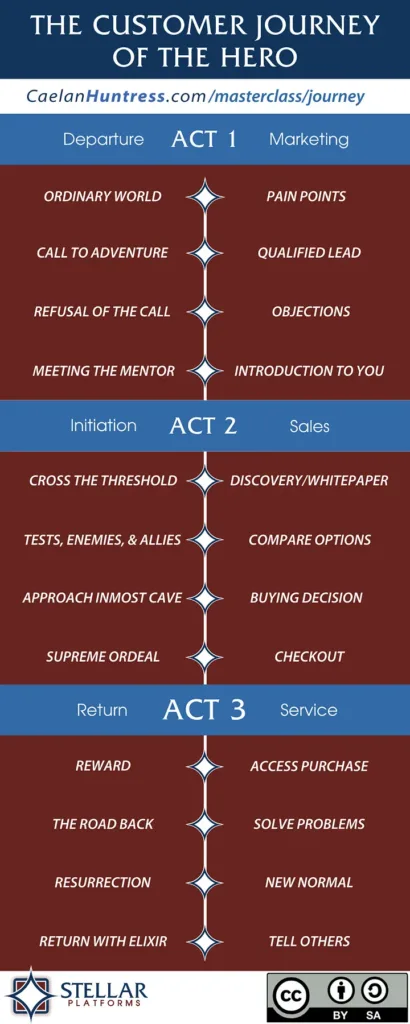
The Customer Journey of the Hero on Your Website
There is a page on your website that you could align with every stage of the Customer Journey of the Hero. It looks like this.
- Homepage
- Subscribe Page
- FAQ Page
- About
- Thank You / White Paper Download
- Case Studies
- Product
- Cart
- Checkout
- Members
- Review
- Share
If you don’t have some of these pages on your website right now, make a note to create them. If the pages don’t currently flow from one stage to the next, challenge your current pages.
- How could your Subscribe page lead to your FAQ page?
- How could your White Paper lead to Case Studies?
- How could your Checkout page lead to a Members page?
- After someone gives you a review, are they given an automated option to share your expertise with others in their own Ordinary World?
If you redesign your website to guide customers through the Customer Journey of the Hero, you will be rewarded as the guide of many quests.
From Star Wars to Moana, from The Matrix to Harry Potter, all the major stories of our culture have followed this journey. Providing your customer with a familiar map will help them follow you on a quest for their purchase.