How McKinsey & Company Stayed Classy with a New Look
Branding is often a fun and colorful ordeal for designers — playing with bold hues, dynamic animations, and playful typography. But what happens when the client is a global consulting giant, known for its serious, professional approach? Designing for McKinsey & Company meant crafting a refined, high-contrast identity that exudes clarity and authority without unnecessary embellishments.
McKinsey & Company, a globally recognized management consulting firm based in New York, USA, collaborated with leading design agencies to revamp its brand identity. The project was led by creative direction from Wolff Olins in London, ensuring a sophisticated and modernized aesthetic. The design execution involved OPX and Signal Noise, both based in London, alongside McKinsey’s internal design team. This collaboration combined strategic expertise and design innovation to create a refreshed identity that aligns with McKinsey’s evolving role in the consulting landscape.
Creating Real Change
McKinsey is the world’s most distinguished firm of management consultants. It helps organizations across the private, public, and social sectors create ‘the change that matters’. McKinsey has always helped its clients identify and set their direction.
“We think the contrast depicts our clarity of thought and our desire to cut through and create change that matters to our clients. It symbolizes our aspiration to bring those qualities to everything we do.”
— Peter Dahlstrom, Senior Partner at McKinsey & Company.
But in the last few years, it’s gone further: it now works with clients to turn these ambitious goals into reality. In fact, over half of McKinsey’s work for clients now is in areas that didn’t exist as little as five years ago. McKinsey therefore wanted to update its visual identity to express this new level of impact.
The New Presence
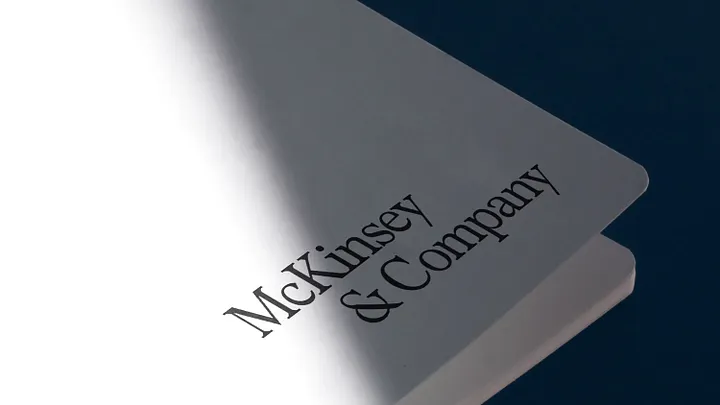
Launched globally in February 2019, McKinsey’s new identity strengthens its presence among clients and in the talent marketplace, reinforcing its stature as a forward-thinking, dynamic organization.
Logo
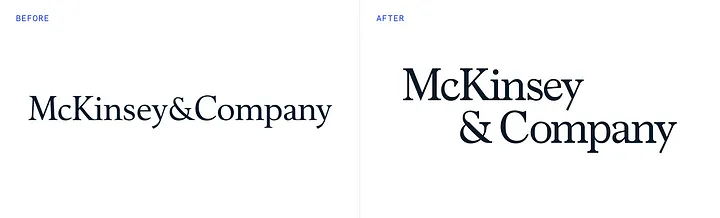
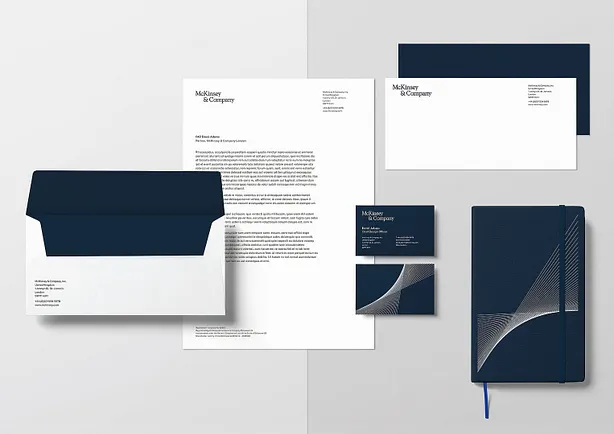
McKinsey’s brand has always centered on partnership — within the firm and with its clients. The iconic McKinsey logo has been modernized with a refined, authoritative typeface, Bower, developed in collaboration with typographer Radim Peško.
The ‘Partnership Mark,’ an animated element, symbolizes McKinsey’s agile teamwork. The core blue remains but is now a deeper, richer shade contrasted against clean white for a sharper, more sophisticated look. This refresh subtly bridges tradition with modernity, ensuring the brand remains timeless yet progressive.

Typography
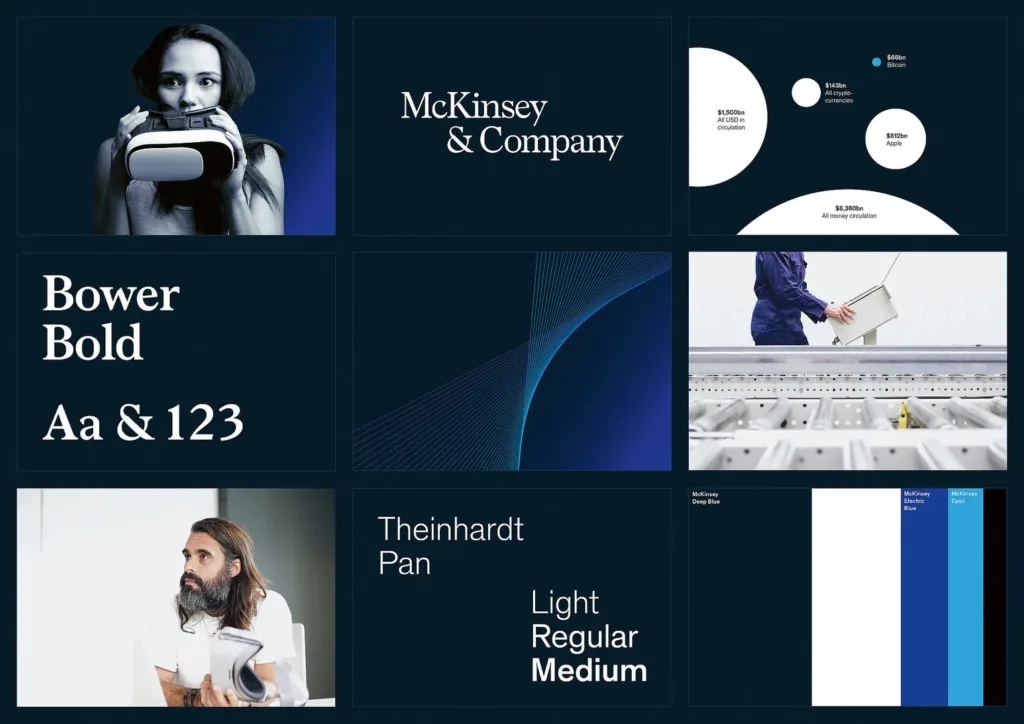
Typography plays a crucial role in McKinsey’s new identity. The contrast between the elegant Bower typeface and the clean, geometric Theinhardt enhances McKinsey’s visual identity, emphasizing clarity and professionalism.
These fonts are carefully chosen to balance authority with accessibility, ensuring that McKinsey’s written materials remain highly legible while exuding a sense of gravitas.


Colors
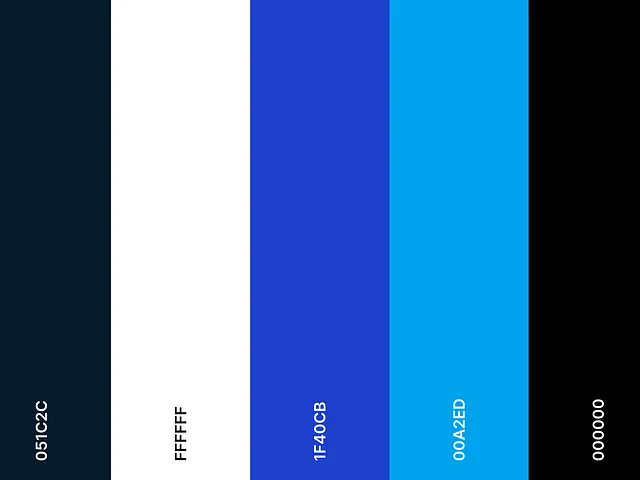
McKinsey retains its signature blue but with more contrast — darker blues deepen its corporate tone, while vivid accents create visual sharpness.
Online and in presentations, white and dark backgrounds mix seamlessly, with soft gradients adding depth. The use of contrast extends beyond aesthetics, serving as a functional tool to guide attention and structure information hierarchically.





Photography and Artwork
A signature blue-line pattern unifies McKinsey’s brand across websites, presentations, and social media. Ensuring visual consistency across thousands of images is challenging for a global firm.
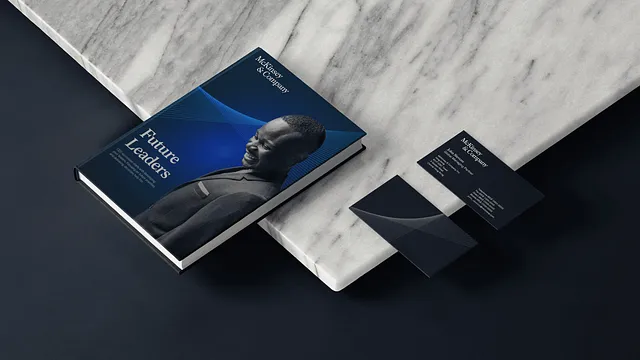
Brilliantly, McKinsey’s approach solves this: all main images are filtered into grayscale, and then accented with blue and purple hues, creating a cohesive, recognizable style. This careful curation ensures that McKinsey’s brand presence remains professional, distinctive, and adaptable across different mediums and cultures.

Icons
Icons play a key role in McKinsey’s branding, making complex concepts more digestible. A custom-designed, minimalist monochrome icon set aligns with the firm’s clean aesthetic.
These icons appear consistently in presentations, emphasizing key ideas while maintaining visual harmony. This uniformity in iconography enhances brand recognition and streamlines visual communication across various platforms.
Powerpoint Template
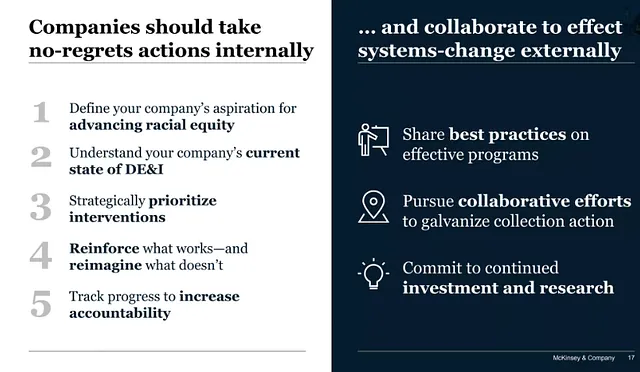
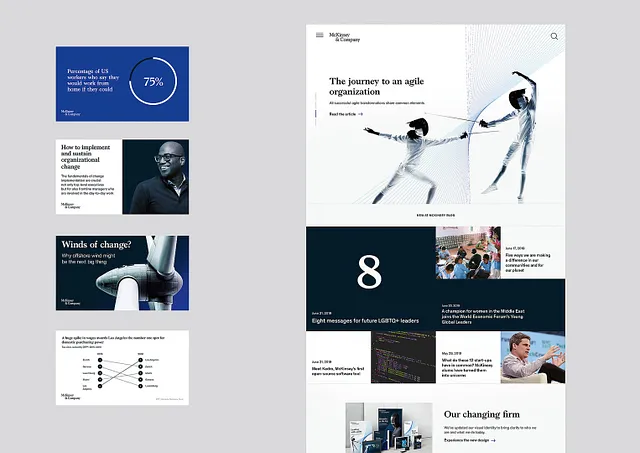
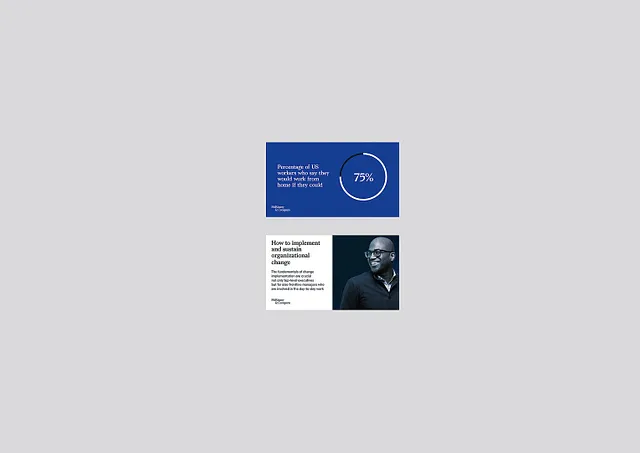
McKinsey’s new PowerPoint template reflects its brand ethos — professional, clean, and minimalist. It retains the white-and-blue palette, with vivid blues used sparingly to highlight key insights.
The design prioritizes clarity, using structured layouts, bold headings, and bullet points. Graphs, charts, and diagrams seamlessly integrate to enhance understanding. The alternating use of white and dark blue slides serves two purposes:
- Contrast: Keeps audiences engaged and differentiates sections.
- Hierarchy & Emphasis: Highlights critical points, with dark blue slides reserved for significant moments such as introductions and conclusions.
This streamlined approach ensures that McKinsey’s presentations are not only visually appealing but also effective in communicating complex data and insights with precision.
Print Design
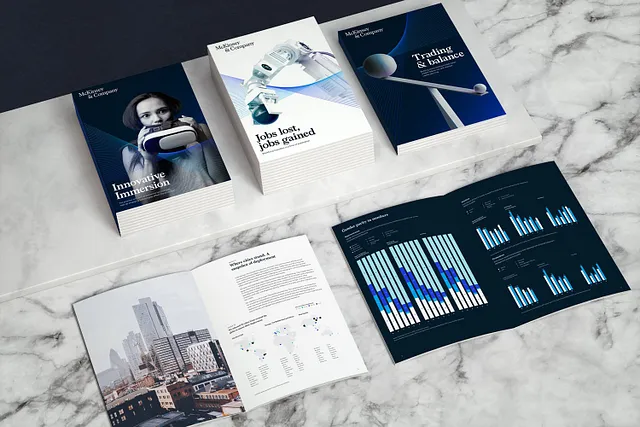
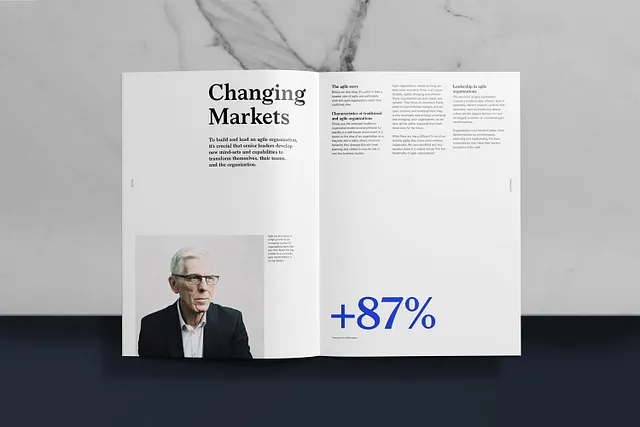
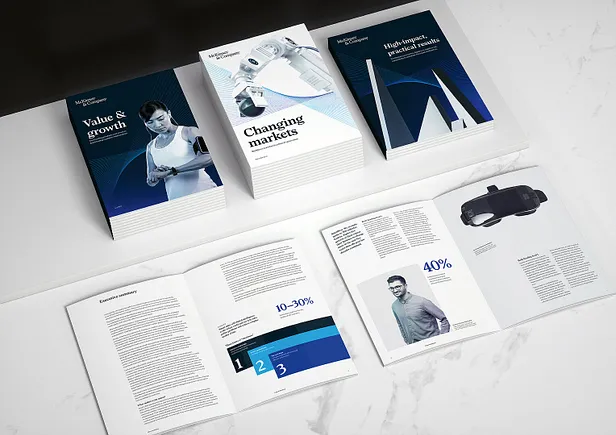
McKinsey’s refreshed branding in print maintains a polished, high-contrast aesthetic. The deep blue-and-white contrast is applied across brochures, reports, and corporate documents, ensuring readability and a premium feel.
Typography and imagery follow the same structured and professional approach, reinforcing McKinsey’s authority in the consulting space. The balance between whitespace and structured content allows for a refined reading experience, making complex reports more digestible.
Web and Mobile
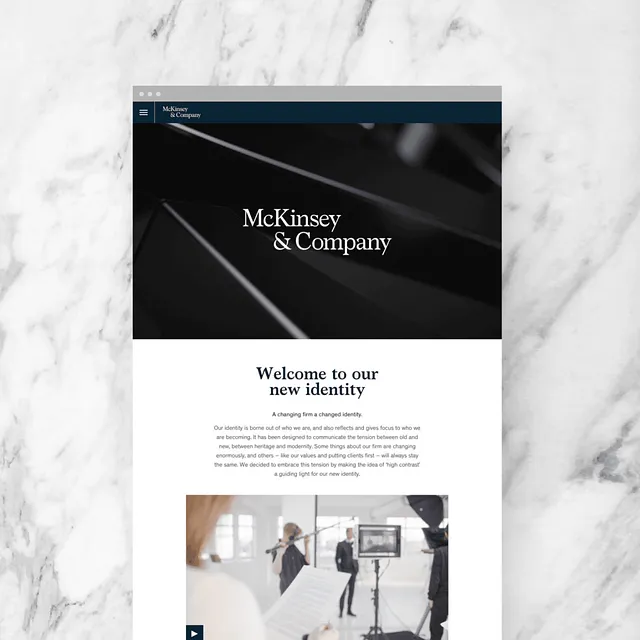
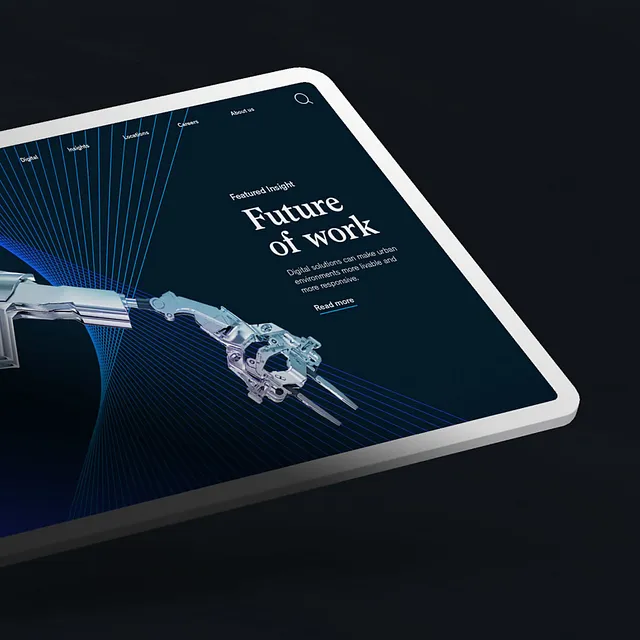
McKinsey’s digital presence follows the same high-contrast principles, leveraging deep blue and white for a clean, modern interface. The website is designed for intuitive navigation, with bold typography and structured layouts enhancing readability.
Mobile responsiveness ensures a seamless experience across devices, with optimized graphics and interactive elements maintaining consistency across platforms. The integration of motion elements — such as subtle transitions and interactive data visualizations — adds a layer of engagement without compromising professionalism.
Change that Matters
McKinsey & Company has changed substantially over the last decade; so much so that 50% of what they do today did not exist five years ago. They needed a visual identity to reflect their modern firm and the commitment to creating “Change that Matters” with their clients.
The new design embraces the concept of “high contrast” as a guiding principle: the color palette sets deep blue against white, and the typography contrasts the characterful Bower against the clean Theinhardt. The distinctive photography style underscores the unique perspective McKinsey aspires to bring to its clients.