How words shape motivation, engagement, and product design
In recent years, gamification has evolved from a trend into a well-established strategy in digital products.
From meditation apps to productivity platforms, digital banks, and loyalty programs, more and more experiences are being designed with game-inspired elements: points, achievements, leaderboards, levels, streaks, badges, narratives, and avatars.
But while product design focuses on systems, flows, and interactions who translates these mechanics into meaningful user experiences? Who turns cold systems into emotional journeys?
Gamification is behavioral design — and words are part of the system
When we examine gamified experiences through a UX Writing lens, content becomes much more than microcopy. It becomes interface, reward system, motivational architecture, and a core element of emotional design.
Words activate neurological triggers, guide behavior, and give purpose to user journeys — drawing on market best practices, neuroscience principles, and storytelling applied to design.
Gamification isn’t just about adding badges or points to an interface. It’s about applying behavioral design and neuroscience to digital products. It works because it activates brain circuits tied to reward and motivation.
When users feel progress, achieve goals, or receive recognition, dopamine is released — a neurotransmitter linked to pleasure and habit formation. Engaging stories and social connections, in turn, trigger oxytocin, reinforcing emotional bonds with the experience.

For UX professionals, that means gamification isn’t just fun or aesthetic — it’s a language of engagement. And content — especially text — is one of its most powerful channels.
In this context, UX Writing doesn’t just accompany the interface — it is the interface. It’s embedded in the mechanics, the feedback loops, the emotional arc.
The UX Writer as a motivation architect
In gamified experiences, UX Writers go far beyond functional microcopy.
We become language strategists and motivation architects. We write not only to guide actions, but to spark emotions: curiosity, excitement, a sense of progress, belonging. Words motivate, celebrate, challenge, and reward.
They give purpose to interactions. And that requires technical skill, narrative sensitivity, and an understanding of human behavior.
A UX Writer in this context must ask:
- What motivates my audience?
- What kinds of rewards do they value?
- How can I turn a difficult task into a meaningful mission?
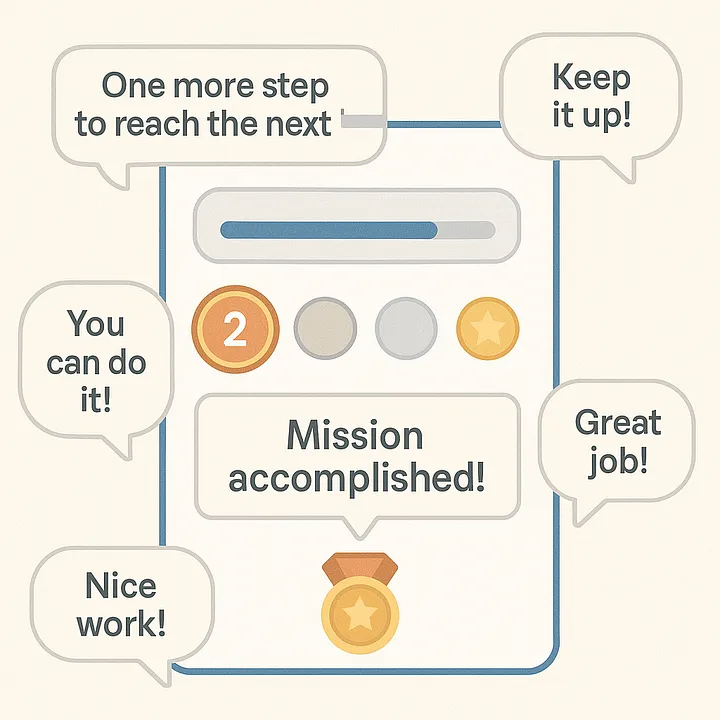
When we know the answers, we can write content that continuously nudges engagement: “You’ve unlocked Explorer Mode!”, “Mission accomplished!” or even “One more step to reach the next level”.
Each line becomes a trigger, reinforcing habits and shaping meaning.
Text as a feedback system
Gamified experiences are systems. And systems must be understandable.
There’s no point in implementing a sophisticated logic of points, progress, and badges if users don’t understand what’s going on. The feedback system needs to be grounded in clarity, visible progress, and celebration. That’s where content bridges the gap between system and user.
Effective UX Writing considers:
- Clear rules: What do I need to do now? Why? What’s in it for me?
- Sense of progress: What’s my level? How far have I come? What’s left?
- Meaningful rewards: Why does this achievement matter to me?
- Contextual feedback: Personalized messages that recognize effort and guide next steps.
For example: instead of simply saying “You earned 5 points,” try:
“You earned 5 points for completing your first task today. Great start!”
This kind of microcopy doesn’t just inform — it motivates. It acts as positive reinforcement and narrative guidance, keeping users engaged even during routine actions.
Writing as the emotional layer of the interface
Gamification is, at its core, emotional design. And content is the language of that design.
When we turn tasks into challenges, actions into achievements, and progress into narrative, we engage users not only cognitively, but emotionally.
Take Duolingo, after completing a lesson, users see lines like: “You’re on fire!” or “Just one step away from the next level!”.
These aren’t just friendly phrases — they’re dopamine triggers that help sustain habits.

Or look at Spotify Wrapped: personalized lines like “You’re in the top 1% of Taylor Swift fans” spark pride, belonging, and viral sharing.
In Structured, a productivity app, each completed task gets visual and textual feedback that mimics the satisfaction of crossing something off a list. This reinforces self-efficacy and supports continuous action.
The power of narrative
Well-crafted narratives can radically transform user experience, using missions, metaphors, and personal agency.
Take Zombies, Run!, a classic example. It turns running into a zombie-apocalypse survival mission. Text guides the user as the protagonist of a story, activating the brain far more intensely than generic instructions ever could.
And even beyond playful contexts, narrative works.
Nubank, for instance, uses expressions like “Mission: save R$100” to make saving money feel less bureaucratic and more approachable.
For UX Writers, this means thinking of content as interactive storytelling. Each line of text is a narrative node, part of a journey with a beginning, middle, and end — all within the product’s universe.
Tone of voice and thematic consistency
If your interface proposes a playful experience, the language must support it. This doesn’t mean infantilizing the content — it means aligning the tone of voice with the emotional atmosphere.
For instance: in a finance app for young adults, a line like “You’ve unlocked Budget Master Mode” might feel empowering. But in a corporate wellness app, that same phrase could feel out of place.
Context is everything. Language must be functional, yes — but also symbolic and emotionally aligned with the brand, the audience, and the moment in the journey.
Not everyone is a gamer
One common pitfall in gamification is assuming everyone understands gaming lingo. That’s simply not true.
Not every user is familiar with terms like “level up” or “XP”.
UX Writers need to make sure the experience is accessible, clear, and inclusive — even for people who’ve never touched a game console.
That means:
- Avoiding jargon and obscure metaphors
- Introducing systems progressively
- Writing content that works with assistive technologies
- Offering alternative paths — because not every user wants to compete or collect badges (sad, but true!)

And since we’re talking best practices for gamified contexts, here’s a quick checklist to keep in mind:
- Build a sense of progression with named milestones, advancement messages, and contextual celebrations
- Use microcopy as reward triggers in buttons, tooltips, notifications, and success messages
- Test metaphors, tone, and vocabulary with real users to fine-tune stimuli and reduce friction
- Align text, visuals, and sound to create a cohesive feedback and narrative system
- Reinforce user autonomy, avoid generic commands and offer clarity at each step
Gamification is a language game – not just an interface one
UX Writing is the craft of creating meaning. And in gamified experiences, that role expands. Text becomes system, interface, story, reward, and motivation.
It’s through words that we turn functional products into memorable journeys. It’s through writing that we turn the user into the protagonist — not just a passenger on this “mission.”
Just as game designers build worlds, we as UX Writers build meaning. Word by word, we give shape to motivation, form to engagement, and soul to the experience.
So if you’re working on digital products and want to make them more engaging — start with content. Because experience begins with the word. And the right words can change the game.