
A 5-level scale to help you decide how to balance between authenticity and efficiency
How to know when you need humans for your content? It’s a real question for every marketing and content leader today.
With AI evolving fast, decisions are harder. On the one hand, you want to be efficient and save time; on the other, you have the urge to stay authentic and personal.
The rule of thumb
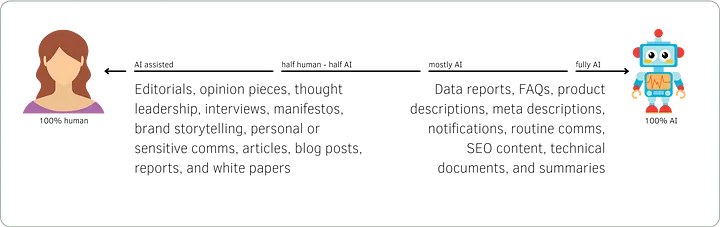
The more personal, authentic, thought leadership and point of view, and the more complex, sensitive, or ethical the topic, the more humans are needed
→ Editorials, opinion pieces, thought leadership, interviews, manifestos, brand storytelling, personal or sensitive comms, articles, blog posts, reports, and white papers
The more standardized with value in the information and not in self-expression, the more you can rely on AI
→ Data reports, FAQs, product descriptions, meta descriptions, notifications, routine comms, SEO content, technical documents, and summaries
Why this matters
use AI where it’s efficient, so you can add humans where it’s needed.
5-level Human to AI scale
This scale tells all. Credits to Paul Roetzer, Founder and CEO of Marketing AI Institute and SmarterX, for this and his insights.
Level 0. Human writer
The unique human voice is essential: editorials, opinion pieces, thought leadership, journalism, interviews, manifestos, and sensitive comms.
Level 1. Mostly human, AI-assisted
The author leads and uses AI for specific tasks. The author retains control over direction and voice: academic papers, articles, blog posts, brand storytelling, reports, editorials, professional comms, thought leadership, and white papers.
Level 2. Half & half, co-writer
The author and AI work together. Focus on efficiency, but voice and human touch matter: articles, blog posts, case studies, email campaigns, press releases, professional comms, and social posts.
Level 3. Mostly AI
AI leads, human refines and approves. Efficiency matters more than human touch: data reports, FAQs, product descriptions, routine comms, SEO content, social posts, and technical documents.
Level 4. All AI
AI writes autonomously with little or no human oversight: business reports, FAQs, meta descriptions, notifications, product descriptions, summaries.
When more human matters
-
- The topic is sensitive, complex, or ethically loaded, and demands an emotional nuance that AI may miss
-
- Your unique voice, perspective, or experience is central — whether for brand identity, creative thinking, or personal storytelling
-
- The content is strategically important to your brand or your personal career, and your audience values your voice and point of view in the message
When to rely on AI for writing
-
- The content is more factual, technical, or follows a standardized format. The value of the content lies in information, not in the self-expression
-
- The tasks are high-volume, repetitive, or routine. This is also a standardization of the messaging and makes the human effort inefficient
-
- Speed matters more than being original; your time can be better spent on higher-value creative work
3 Tips and my preference
-
- If you want to be a thought leader, don’t let AI do all the work. Besides writing, you can use AI excellently to research, get ideas, or break through a writer’s block.
-
- Or simply run your copy through AI for proofreading and minor improvements
-
- Always consider a potential bias in AI. Fact-check everything, as AI is also great at hallucination
-
- And disclose AI assistance when transparency matters to your audience.
-
- There’s no shame in using AI; it isn’t lazy, it’s efficient. It frees you to focus on what matters most, creating high-quality content
For these reasons, my preference is to balance my content between levels 1 and 2, mostly human and AI-assisted. I use AI to free up headspace and time for my creativity.
I always write the outline by hand, old-school style, with pen and paper. It slows me down in a good way. It sharpens my message.
When I go for AI-powered or fully AI-generated, I miss the spark and a sharp edge. No matter how much I configure AI and prompt, it just misses the oomph.
Wrapping it up
AI is a tool. Your voice is the differentiator. Use AI to scale speed. Use humans to build trust, authority, and originality.
Always remember that you’re responsible for the output. You can never blame AI for writing it and making mistakes.
I like this scale with the examples to give guidance.
-
- The more personal, authentic thought leadership and point of view, and the more complex, sensitive, or ethical the topic, the more humans are needed
-
- Think about editorials, opinion pieces, thought leadership, interviews, manifestos, brand storytelling, personal or sensitive comms, articles, blog posts, reports, and white papers.
-
- The more standardized with value in the information and not in self-expression, the more you can rely on AI
-
- For example, data reports, FAQs, product descriptions, meta descriptions, notifications, routine comms, SEO content, technical documents, and summaries