They’re far better
I’m afraid I have some difficult news to share with you. After careful examination of your career aspirations, I’m diagnosing you with a severe case of “I Can Actually Make Money Writing.”
Don’t panic! It’s not as bad as it sounds. It’s nothing physical. It’s merely a mental delusion. And it’s treatable! However, I have to warn you. The recovery process involves accepting that most successful writers have day jobs, occasional panic attacks, and a profound understanding of dollar store cuisine.
The good news? This condition is surprisingly common and rarely fatal.
Wait! Don’t throw your coffee mug at me just yet. I’m not saying writers should take a vow of poverty and survive solely on expired ramen soaked in the tears of rejected manuscript submissions. By all means, sell your soul — I mean, your work! Take the money! Cash those checks! Buy yourself something nice, like… groceries!
There’s absolutely nothing wrong with writing for money. It’s just that writing is about as effective a money-making strategy as beekeeping. I mean, sure, you can probably make a few bucks selling honey at the farmer’s market. But is it really worth getting stung seventeen times while you’re trying to milk honey from the queen bee’s tiny udders? (Note: Please don’t actually try to milk bee queens. They’re surprisingly litigious.)
So if not money, then what?
If writing isn’t your ticket to financial freedom, then why even put yourself through this agony? Why develop carpal tunnel for an audience that may never exist? Why stare at blank pages like they peed in your Nana’s denture cup?
The answer matters more than you might think.
Why your “why” matters
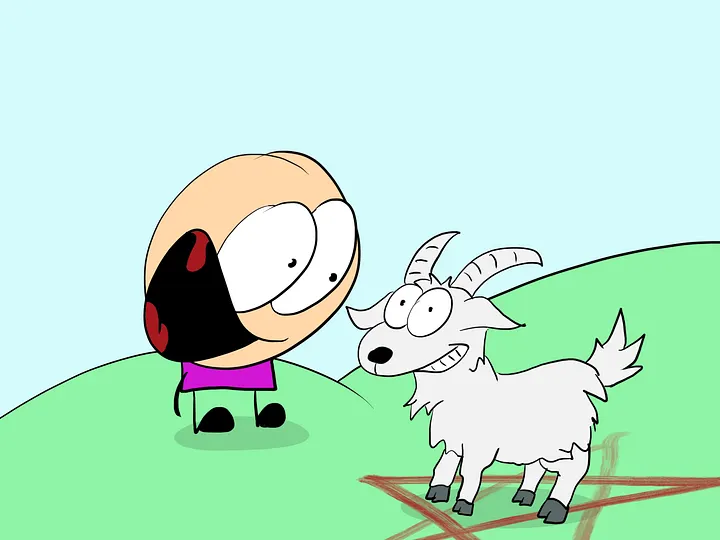
Let’s say you decide to adopt a Tibetan Quarrelhorn Blaze goat. At first glance, this goat is absolutely adorable. Tiny! Fluffy! How hard could it be to care for something so cute?
[Insert maniacal laughter from experienced goat owners]
Soon you discover that your precious little goat is actually a four-legged chaos demon so destructive it would make the Dalai Lama drop his prayer beads and scream ‘What the f*** is wrong with this animal?!” This hellish creature demands a diet of rare orchids that only bloom during solar eclipses, requires 24/7 emotional support because it has abandonment issues stemming from ancestral yeti trauma, and possesses the supernatural ability to teleport through any barrier known to mankind.
If you don’t know WHY you signed up for this supernatural nightmare in the first place, you’re going to find yourself at 4 AM, covered in orchid petals and goat poop, screaming into the void, wondering how your life came to this.
But if you know your reason — maybe you’re exploring masochism or conducting groundbreaking research on interdimensional livestock — then suddenly all this insanity becomes part of your twisted journey. You get in touch with quantum physicists to find a fencing solution. You develop a network of yeti impersonators on Craigslist. You launch a GoFundMe called ‘Help Me Contain This Hellbeast’ and somehow make it work
Writing is exactly like raising such an imaginary high-maintenance goat, with approximately the same amount of headbutting, but fewer bleating sounds. If you have a reason, it’s tolerable — even fun. If not, it’s pure hell.
A buffet of writing reasons
So if it’s not money, what are the good reasons to write? Buckle up, buttercup, because there are more options to choose from than goats on my roof:
Writing for self-expression
This is the classic “feelings dump.” You know those moments when emotions are bubbling up inside you like a shaken soda can? Writing gives you a safe place to release the pressure without the chaos bursting out of your nostrils and spraying all over innocent bystanders. So if self-expression is your WHY, then you write
- to give shape to emotions
- to express joy
- to express grief
- to express love
- to express anger
- to celebrate beauty
- to confess secrets
- to make sense of complex feelings
- to, in a word, express what’s bubbling inside you.
Writing for clarity
This is writing as mental housekeeping. Your brain collects clutter the way a dryer collects lint — messy, flammable, and entangled. Putting words on paper is how you clear it out and see what’s really going on. So if clarity is your WHY, then you write
- to free the mind from clutter
- to better understand yourself
- to organize thoughts
- to solve problems
- to clarify decisions
- to learn what you truly believe
- to observe patterns in your life
- to track changing opinions
- to untangle confusion
- to turn vague ideas into clear ones
- to challenge your own logic
- to, in a word, clarify what you’re thinking.
Writing for memory
This is writing as your external hard drive. Memories vanish, dreams evaporate, and whole weeks get swallowed by the black hole called “life.” Writing pins things down so you don’t lose them to the void. So if memory is your WHY, then you write
- to leave a trace of your life
- to record dreams
- to capture daily events
- to document progress
- to remember people you love
- to prepare a legacy
- to safeguard fleeting thoughts
- to create family stories
- to, in a word, preserve memories.
Writing for creativity
This is writing as playtime. It’s recess for your imagination, a chance to run wild without a hall pass. Reality may have rules, but your notebook doesn’t. So if creativity is your WHY, then you write
- to invent worlds
- to explore “what if” scenarios
- to play with language
- to experiment with style
- to surprise yourself
- to, in a word, exercise your creativity.
Writing for healing
This is writing as DIY counseling. The page is your unlicensed therapist: it doesn’t interrupt, it doesn’t judge, and it doesn’t charge by the hour. So if healing is your WHY, then you write
- to process trauma
- to reduce anxiety
- to slow racing thoughts
- to unload burdens
- to practice gratitude
- to strengthen resilience
- to forgive others
- to forgive yourself
- to heal from loss
- to calm the nervous system
- to, in a word, stop you from going crazy.
Writing for communication
This is writing as a means to teleport ideas. You beam your thoughts into someone else’s head without ever being in the same room — or the same century. So if communication is your WHY, then you write
- to persuade
- to share knowledge
- to entertain
- to make people laugh
- to move people to tears
- to comfort
- to warn
- to inspire
- to, in a word, share your thoughts with others across time and space.
Writing for learning
This is writing as a means of feeding your brain with knowledge and skills. Every time you put pen to paper, you’re not just recording what you know — you’re discovering what you didn’t. So if learning is your WHY, then you write
- to deepen understanding
- to test new skills
- to explore other perspectives
- to practice languages
- to document research
- to reflect on teachers and mentors
- to work through mistakes
- to, in a word, consolidate learning.
Writing for work
This is writing as professional leverage. It may not make you a millionaire, but perhaps it can help you pay bills, build credibility, and keep you from sounding like a caveman in your emails. So if work is your WHY, then you write
- to find clients
- to build reputation
- to sell something
- to market ideas or products
- to negotiate more effectively
- to create proposals and pitches
- to stand out in a noisy marketplace
- to, in a word, beef up your actual career (whatever it might be).
Writing for enjoyment
This is writing as fun for fun’s sake. No deadlines, no pressure, no agenda — just you goofing around with words like a kid making faces in front of the mirror. So if joy is your WHY, then you write
- to play with rhythm
- to enjoy word sounds
- to doodle with sentences
- to invent nonsense
- to explore surreal ideas
- to let your inner child speak
- to turn boredom into invention
- to, in a word, amuse yourself
The Bottom Line
Whether you’re writing to heal your soul, organize your thoughts, create magical worlds, or just because you enjoy the satisfying click of keyboard keys, knowing your “why” is like having an owner’s manual for your interdimensional farm animal. Without it, you’re just googling “goat exorcism near me” and getting frustrated because you’re finding surprisingly few helpful results.
So take a moment to think about it: Why do you write?
Done? Great! Now that you figured that out, everything else — the rejections, the writer’s block, the deadlines, the 3 AM editing sessions — is still going to suck. But it’s going to suck less. And, more importantly, you’ll be able to keep going even though it sometimes sucks.
Now if you’ll excuse me, I need to go check on my goat. I think he’s figured out how to telepathically control the president of the United States and I need to distract him with some Tibetan throat singing before he unleashes more chaos onto the world.
Want more fun illustrated essays on writing? Then subs